
Part One: Understanding Our Role in Our ADHD Journey
How AI Can Help Us Advocate for Ourselves More Confidently

In my experience, self-advocacy was one of the hardest parts of living with ADHD. At first, speaking up about what I needed—to a doctor, teacher, or support person—made me feel ashamed and powerless. My thoughts raced. Overwhelmed by anxiety and self-doubt, I often froze. Sound familiar? That’s why reflection matters—because it helps you see the value in asking thoughtful questions, and AI can help us build this skill.
How?
When thoughtfully used, AI tools help organize thoughts, highlight priorities, and practice self-expression, making self-advocacy more manageable and effective. And while not a replacement for in-person support, AI can guide us in answering questions like these and empower us to communicate more confidently and clearly without the fear of being judged or misunderstood.
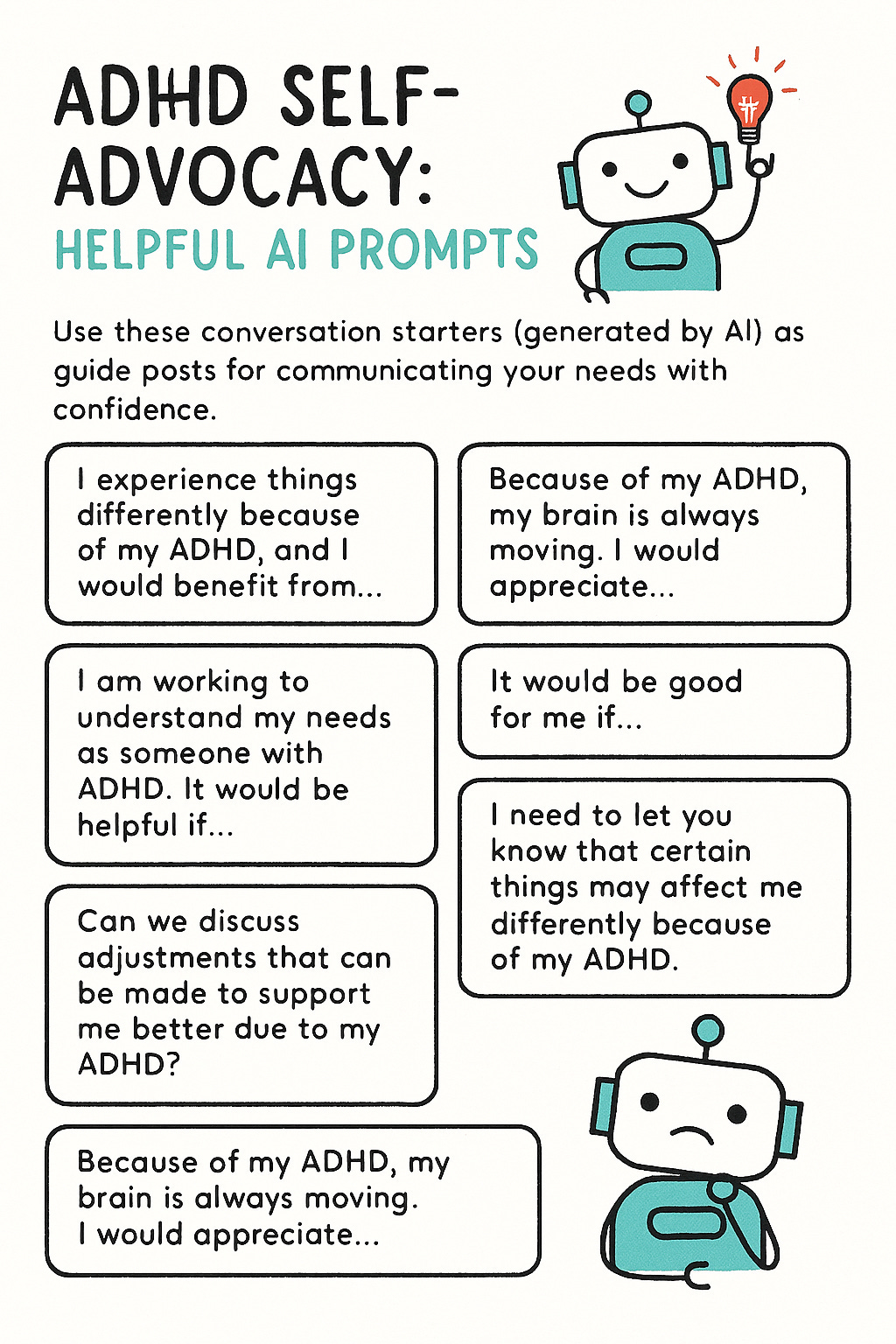
Here are some prompts I have found helpful in my ADHD journey.
What are some online and in-person resources I can look at to better relate to myself and navigate the world around me?
Highlight two or three key points to discuss in my next appointment?
How can I talk about a challenging topic?
What are online support groups that focus on ADHD?
What information will be helpful to bring to the next appointment (Brown, 2013)
What little things or habits helped me stay on track this week?
What patterns do I notice in how I react to stress or changes, and how can I use the things of my control over to cope with the things I don’t?
What’s one intention I want to set for today? And one for this week?
When Can AI Be Helpful In Our Self-Advoacy Journey?
Between appointments
ADHD care happens 24/7, every day of the year, not only during our visits, even through our healthcare team is a vital part of our self-care and maintaining our mental health. AI can support that reflection without turning life into a rigid tracking project by making things feel less overwhelming.
Advocating Without Getting Too Overwhelmed
Self-advocacy does not require handling, but when it is done wrong, or we go to the wrong people or use the wrong resources, it can be exhausting.
For this reason, when AI is used properly when the right professional guidance, it can be a useful tool. In helping us organize our thoughts, highlight priorities, and draft questions that make communication easier for us. (While being non-judgmental)
Helping us focus on the people and strategies that support us while building habits that reinforce clarity, consistency, and confidence in our care.
AI used this way helps us arrive at appointments better prepared, more regulated, and more connected to what is happening in real life. Treatment becomes something actively shaped rather than passively endured.
On A Final Note, Remember
AI or any other app should never replace mental health support or professional treatments from real people. Why? It cannot diagnose, provide therapy in the same way, or manage crises. It can, however, be a helpful tool for organizing thoughts, planning days, managing tasks, reflecting, or preparing for sessions with a professional.
Ultimately, decisions about assessment, treatment, and emotional support should always be guided by trained providers (Brown, 2013; Elwyn et al., 2012). Like any self-care or treatment, even with AI, consult your doctor, therapist, or support team to ensure it’s safe, effective, and personalized.
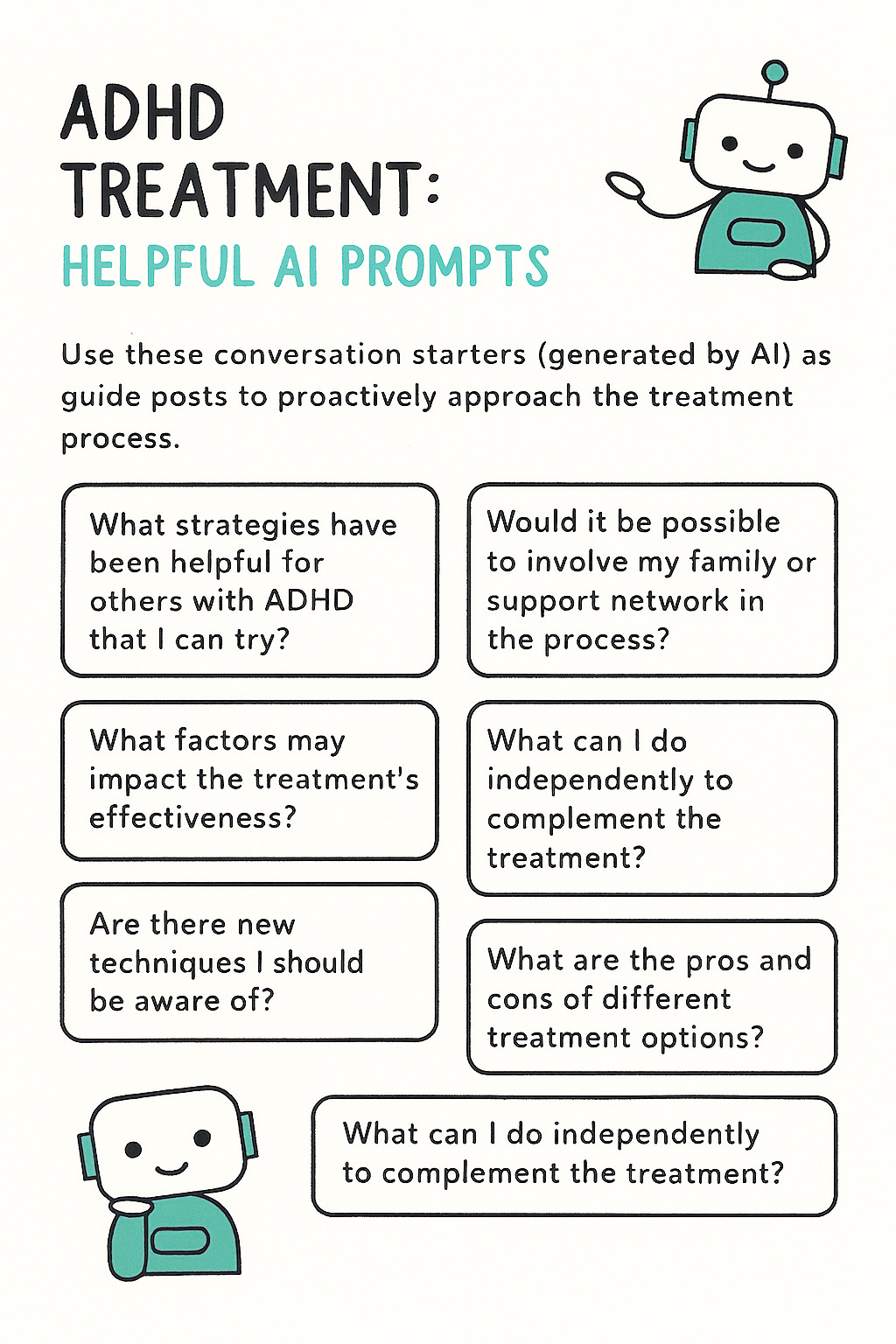
Here are a couple of worksheets to guide you—thank you for making my blog part of your journey. Before adding this, ask your health team how it might help and whether it fits your current stage.
In the follow-up blogs on this topic, I will be discussing the following:
Part 2: Building Self-Advocacy Skills
Part 3: Thriving Through Support Systems and Understanding Our Role in Those Systems
Past Related Blogs
Helpful vs. Unhelpful Intentions When You Have ADHD – Moderate Stoner Substack: https://open.substack.com/pub/moderatestoner/p/helpful-vs-unhelpful-intentions-when
Part One: Free ADHD iOS/Android Apps For Supporting Our ADHD Brains – Moderate Stoner Substack: https://open.substack.com/pub/moderatestoner/p/part-one-free-adhd-iosandroid-apps
Part Two: Free AI-Powered Apps for ADHD Brains: Top iOS & Android Helpers That Won’t Cost a Dime – Moderate Stoner Substack: https://moderatestoner.substack.com/p/free-ai-powered-apps-for-adhd-brains
Friend Support vs. Professional Support vs. Supporting Yourself: Your Mental Health Toolkit: https://moderatestoner.substack.com/p/part-2-building-better-supports
References
Brown, T. E. (2013). A new understanding of ADHD in children and adults. Routledge.
Elwyn, G., Frosch, D., Thomson, R., Joseph-Williams, N., Lloyd, A., Kinnersley, P., … & Barry, M. (2012). Shared decision making: A model for clinical practice. Journal of General Internal Medicine, 27(10), 1361–1367.
https://doi.org/10.1007/s11606-012-2077-6
Hibbard, J. H., & Greene, J. (2013). What the evidence shows about patient activation: Better health outcomes and care experiences; fewer data on costs. Health Affairs, 32(2), 207–214.
Your AI prompts for appointments bridge reflection to action nicely—self-advocacy shame is real for many post-diagnosis. Between visits, that 24/7 care angle shifts responsibility gently. Which prompt has sparked the best habit change in your routine?