
Simple Ways to Gamify Your Week When You Have ADHD

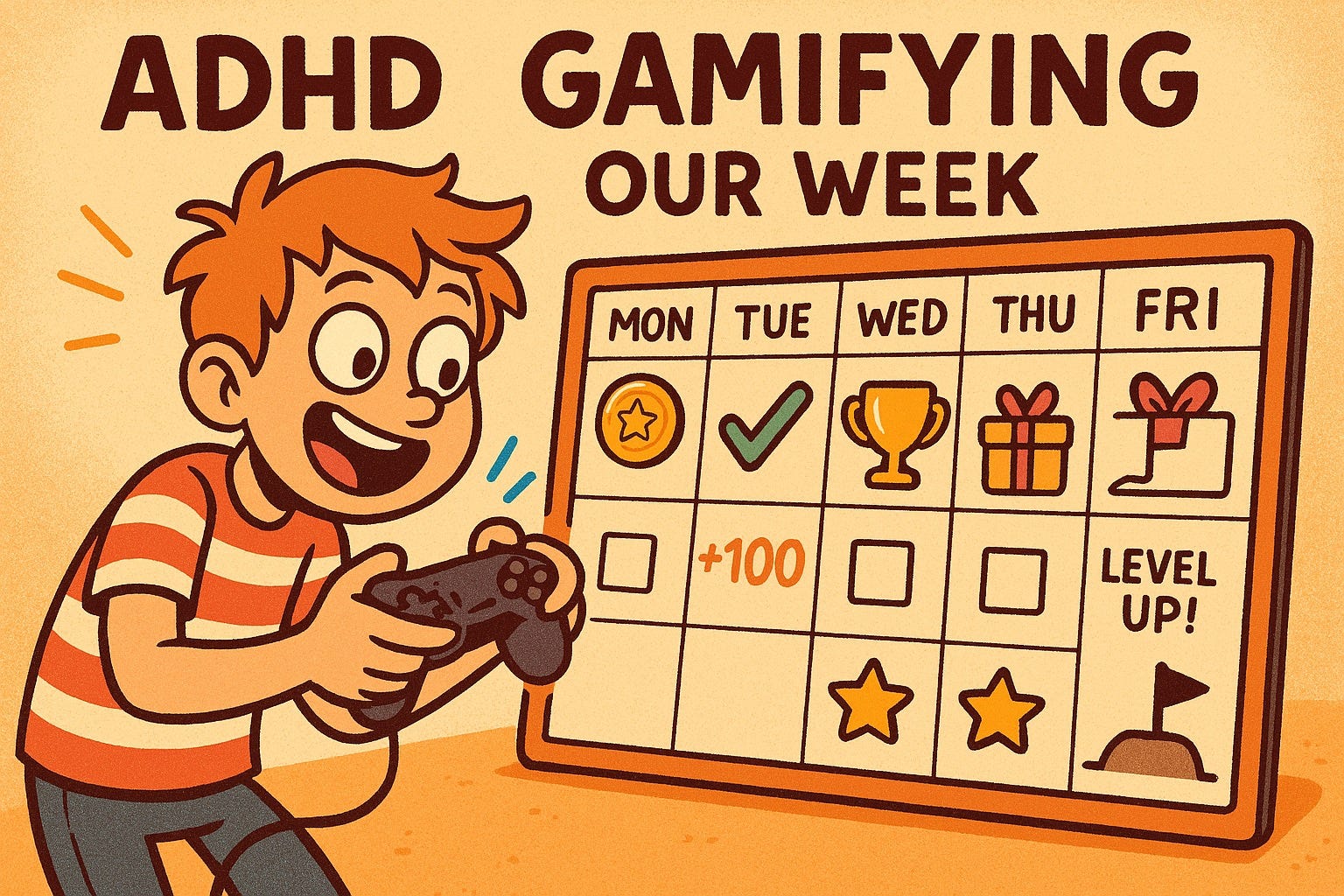
If you’ve ever felt like your week is a wall of dull and overwhelming obligations, you’re not alone—especially if you have ADHD. I know it can make starting and finishing tasks nearly impossible to accomplish. But here’s the good thing: there is hope and various techniques designed to help motivate and organize our ADHD brains.
How does Gamification work? By adding points, quests, timers, and rewards, in other words, gaming is not just for video gamers. It can be a tool and a powerful dopamine booster that energizes and makes ordinary routines fun.
Why The Gamify Approach?
For many with ADHD, tasks that lack motivation and excitement can feel like invisible obstacles. Gamification brings back visibility, structure, and a quick dopamine hit. It turns “should-do” chores into “I want to, even just a little.” But in a way that helps us work with our ADHD and in a way that teaches us with the right tools, we've got this motivation thing down.
Even in classroom settings, gamified systems significantly improved focus and task completion in neurodiverse learners. One study found task completion rates increased from 63.2% to 87.4%, while average focus time rose from 18.5 to 28.7 minutes (Mulcahy et al., 2023). If gamification can create this level of change in a complex learning environment, imagine the impact it could have on your week.
Tips to gamify your week.
Making a Weekly Points System
Set up a simple points system for the week—assign points to tasks and reward yourself when you pass certain thresholds. For example, you could aim for 150 points to enjoy a 30-minute social-media break, or 200 points to treat yourself to an episode of your favorite show. It’s simple and motivating, and it lets you see your progress stacking up and how you can create new habits and routines with the right motivators.
Going Old School With A DIY Punch Card
Remember loyalty punch cards or apps used not to do the same thing? Creating a “punch card” with your habits or routines —each punch has the potential to become visually satisfying. Why? Each tick, check, or punch gives you a dopamine boost and turns goal-tracking into a tactile, creative experience. Punching the card and seeing your progress makes goals feel more tangible and fun, and it can give you a sense of accomplishment.
Use Gamified Apps (or Analog Games) That Fit Your Style
Habitica turns your to-do list into a quirky RPG. Complete tasks to gain experience and gold, and level up your avatar.
Spirit City: Lofi Sessions lets you lure whimsical spirits by completing real-world tasks.
Virtual Cottage gives you a calming workspace with a little avatar companion and ambient sounds—a nice visual nudge to keep going.
Hero App: This is a 100% free app that is an AI assistant and really helpful and easy to use.
If apps feel overwhelming, analog methods—like pen-and-paper trackers or your phones note pad—also work.
Turn Tasks into Time-Based Challenges
Set a timer for creating short, achievable goals. For example, the Pomodoro technique—25 minutes of focus, then a 5-minute break—is a tried-and-true ADHD-friendly rhythm. It creates a game of “beat the clock,” making even small tasks feel urgent and satisfying. Break bigger weekly goals into bite-sized, timed chunks.
Try Body-Doubling as a Live Game Element
Bring someone along—physically or virtually—to act as a body-double. They simply sit with you while you work, helping keep you on task and helping you stay task- and goal-focused. Many people with ADHD call this a secret productivity superpower. Think of it as a live multiplayer mode—two players, one focused goal.
Putting It All Together for a Gamified Week
Here is an example of how you may structure your week:
Monday: Create your points tracker or punch card and assign your realistic weekly goals; for example, you get 100 points for accomplishing that goal.
Every morning: Choose 2-3 key tasks to finish and add a timer to make them into mini-games. I will get ready in the washroom in this amount of time.
Using visual trackers: Putting a punch on your card or stacking points in a chart, you can see.
Creating a midweek check-in and acknowledging your progress. Give yourself a small reward if you’ve hit the halfway point of your weekly goals.
Invite a body-double: Schedule a co-working session to make Thursday’s work block more engaging or something else you find motivating.
Friday reward: When you reach your weekly and daily checklists, or punch-card, celebrate—watch a show, grab a treat, or savor the win.
Remember: Focus on what works for you and start with little steps and reminders, depending on where you are in your journey.
Conclusion
Gamifying your week isn’t about tricking yourself into doing work or having a problem-free week. It is about aligning your environment with your brain's natural workings. In other words, learning to work with our ADHD and learning about what motivates us is a big part of this process.
For those with ADHD, novelty, immediate feedback, and small rewards are more than perks; they are our fuel for overcoming our big and little milestones. Playful elements, visible progress markers, and rewards can make your week feel less like a grind and more like a series of small, winnable adventures. And the more you play, the more you’ll win, so keep going by empowering us to reframe our daily, weekly, monthly, and yearly goals.
References
Centers for Medicare & Medicaid Services. (2007). State Medicaid Director's letter on peer support services. https://www.healthline.com/health/adhd/gamification-for-adhd
Earth Coaching. (n.d.). Gamifying boring tasks. https://www.earthcoaching.net/blog/gamifying-boring-tasks
Habitica. (n.d.). Habitica. https://en.wikipedia.org/wiki/Habitica
Healthline. (2022). Gamification for ADHD. https://www.healthline.com/health/adhd/gamification-for-adhd
Polygon. (2023). Best productivity games. https://www.polygon.com/what-to-play/457324/best-productivity-games
Sunsama. (n.d.). How to gamify work tasks. https://www.sunsama.com/blog/gamify-work-tasks
Talkspace. (n.d.). ADHD hacks. https://www.talkspace.com/mental-health/conditions/articles/adhd-hacks
Verywell Mind. (2024). The punch card trend. https://www.verywellmind.com/what-is-the-punch-card-trend-11703375
Wikipedia. (n.d.). Gamification of learning. https://en.wikipedia.org/wiki/Gamification_of_learning
Wikipedia. (n.d.). Body doubling. https://en.wikipedia.org/wiki/Body_doubling